Iran’s Ultimate Instrument of Economic Deterrence: The Strait of Hormuz
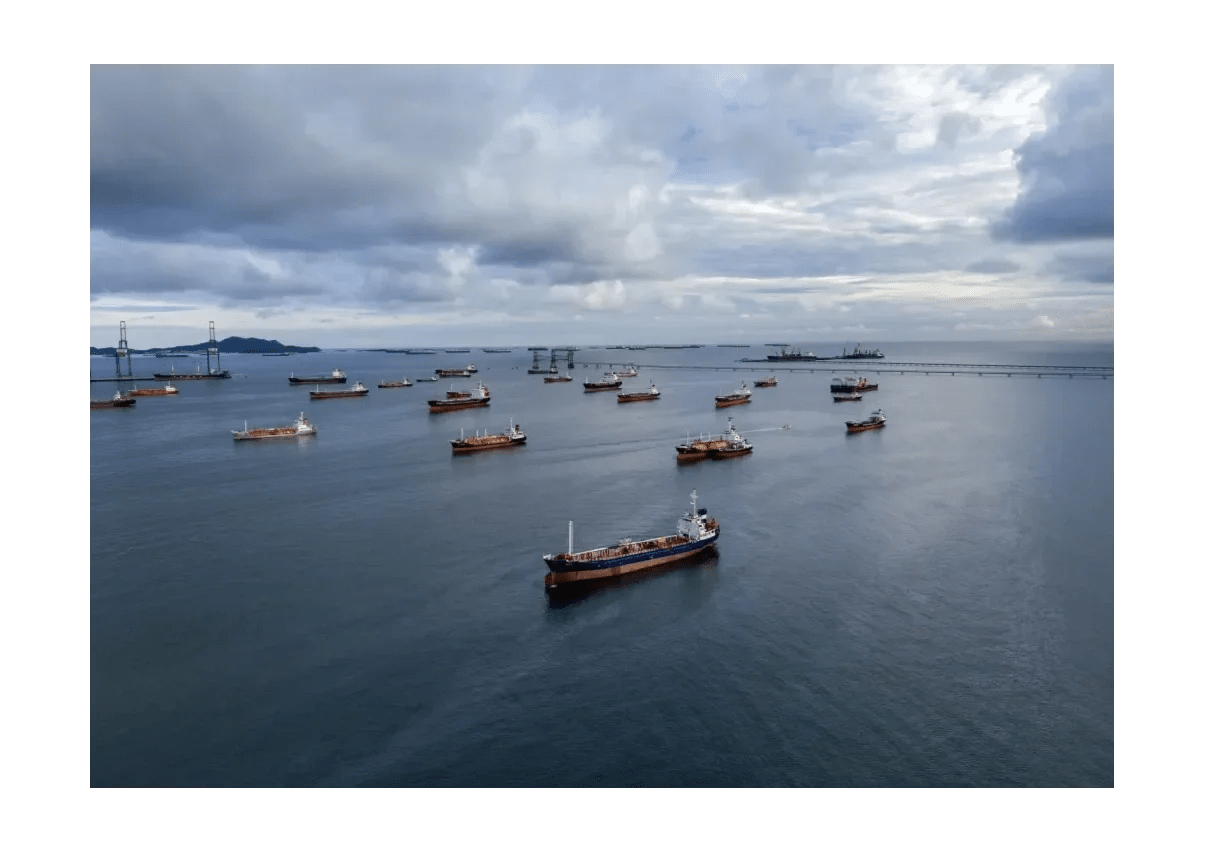
Getty Images: Ships parked in Straits of Hormuz
Introduction
In times of heightened confrontation between Iran and the United States, much attention is understandably directed toward military capability, missile exchanges and the prospect of regional escalation. Yet one of Iran’s most consequential instruments of power may not lie solely in its ballistic arsenal or regional proxy network, but in its geographic position astride one of the world’s most strategically important maritime chokepoints, the Strait of Hormuz. While military planners often focus on kinetic warfare, the closure or disruption of this narrow waterway has the potential to trigger economic consequences on a global scale, extending far beyond the Middle East.
The Strait of Hormuz represents more than a shipping lane. It is arguably Iran’s most powerful tool of economic deterrence. Through either direct closure, harassment of shipping, mining operations, or the mere credible threat of disruption, Iran possesses the capacity to impose severe economic costs on adversaries without engaging in conventional military parity. Such a capability fits within Tehran’s long-standing reliance on asymmetric methods to offset its comparative military disadvantages against technologically superior opponents, particularly the United States (Cordesman, 2014).
Approximately one-fifth of global oil consumption passes through the Strait of Hormuz daily, making it one of the most economically sensitive maritime corridors in the international system (U.S. Energy Information Administration, 2024). Any prolonged disruption would almost certainly result in surging oil prices, inflationary pressure, financial market instability and interruptions to global supply chains. The effects would not be isolated to the Gulf region but would reverberate through Europe, Asia and North America, affecting energy markets, manufacturing costs and domestic political stability.
The question therefore is not simply whether Iran could close the Strait of Hormuz, but whether the threat of doing so constitutes a form of deterrence in itself. From an international relations perspective, this issue highlights an important debate between realist assumptions about coercive state behaviour and constructivist interpretations surrounding identity, resistance and political signalling. Iran’s approach to Hormuz cannot be understood purely through military logic alone. It also reflects the political narratives Tehran has developed since the 1979 Islamic Revolution, particularly its resistance to Western pressure and perceived economic encirclement (Wendt, 1999).
Why the Strait of Hormuz Matters
The strategic significance of the Strait of Hormuz stems largely from geography. At its narrowest point, the waterway measures roughly twenty-one miles wide, with shipping lanes confined to only a few miles in either direction. This geographical limitation creates a natural chokepoint vulnerable to disruption by even relatively limited military capabilities.
Major Gulf energy exporters, including Saudi Arabia, Iraq, Kuwait, Qatar and the United Arab Emirates, rely heavily on this maritime passage to transport crude oil and liquefied natural gas to international markets. For many Asian economies, particularly China, India, Japan and South Korea, uninterrupted Gulf energy supplies remain essential for industrial production and economic stability (International Energy Agency, 2024).
What makes the Strait uniquely vulnerable is that Iran does not necessarily need to fully close it to create economic stress. Even a perception of instability or temporary disruption can trigger substantial reactions in global markets. Insurance premiums for oil tankers rise sharply during periods of tension, shipping routes may be reconsidered, and energy traders frequently respond to geopolitical uncertainty through speculative pricing. In practical terms, the fear of disruption may sometimes be almost as economically damaging as disruption itself.
History provides several examples of this dynamic. During the Iran–Iraq War of the 1980s, the so-called ‘Tanker War’ saw attacks on oil tankers transiting the Gulf, increasing global anxiety about energy security. More recently, attacks on shipping in 2019, including incidents involving tankers near the Gulf of Oman, reignited fears over maritime vulnerability and were widely interpreted as signals of Iran’s willingness to remind the international community of Hormuz’s strategic importance (Knights and Eisenstadt, 2019).
For Iran, this creates an important strategic calculation. Tehran understands that it cannot compete symmetrically with the United States in conventional military terms. Instead, it seeks leverage through asymmetric pressure points where economic vulnerability outweighs military superiority. The Strait of Hormuz provides precisely such leverage.
Iran’s Strategy of Economic Deterrence
Deterrence is traditionally understood as the ability to persuade an adversary against taking action through the threat of unacceptable consequences (Schelling, 1966). In the case of Iran, deterrence increasingly extends beyond missiles and military retaliation toward economic disruption.
Iran’s messaging surrounding the Strait of Hormuz has often emerged in response to sanctions, military threats or heightened diplomatic pressure. Iranian officials have repeatedly warned that if Tehran’s oil exports are prevented through sanctions, regional energy exports may also face disruption. In effect, the message has often been framed as: if Iran cannot sell oil, others may struggle to do so as well.
This strategy reflects rational cost imposition rather than irrational escalation. From Tehran’s perspective, threatening Hormuz introduces uncertainty into the calculations of Western policymakers. Any military strike against Iranian infrastructure must therefore account for potential second-order effects: rising oil prices, inflation, political dissatisfaction at home and broader instability in allied economies.
The economic consequences of even a temporary closure could be profound. Analysts have suggested that major disruption to Hormuz could result in oil prices exceeding $150 per barrel, potentially triggering recessionary pressures in major importing economies (Fattouh and Economou, 2020). Europe, already vulnerable to energy insecurity following geopolitical disruptions elsewhere, would likely experience renewed inflationary shocks. Asian economies dependent on Gulf energy imports would face industrial slowdowns, while shipping and insurance sectors would encounter heightened operational risk.
For the United States, while domestic shale production offers some insulation compared with earlier decades, the interconnected nature of global energy markets means that American consumers would still experience higher fuel prices and inflationary pressure. Political consequences at home could therefore become an important strategic consideration.
In this sense, Iran’s threat concerning Hormuz functions not merely as military signalling, but as a form of economic coercion designed to alter adversarial decision-making. The credibility of such deterrence lies not necessarily in whether Iran would permanently close the Strait, but whether policymakers believe Tehran possesses both the capability and willingness to impose sufficient disruption to make military action politically and economically costly.
Realist Perspective: Economic Coercion and Asymmetric Power
From a realist perspective, Iran’s reliance on the Strait of Hormuz reflects a rational strategy of survival within an anarchic international system. Realist theory assumes that states act primarily to preserve security and maximise their relative power in response to external threats (Waltz, 1979). For Iran, whose conventional military capability falls short of that possessed by the United States and its regional allies, asymmetric leverage becomes essential.
Rather than seeking parity in air power, naval superiority or advanced military technology, Tehran has historically developed strategies designed to raise the costs of confrontation for stronger adversaries. The Strait of Hormuz fits neatly within this logic. Geography provides Iran with an opportunity to compensate for military imbalance through economic leverage. By threatening global energy flows, Iran can potentially impose costs that exceed the immediate battlefield.
Realists would argue that this form of deterrence is fundamentally rational. As John Mearsheimer (2001) suggests, states pursue strategies that maximise their chances of survival in environments characterised by uncertainty and insecurity. Iran’s leadership understands that it cannot prevent military action solely through conventional force. However, if Tehran can convince adversaries that military escalation would generate severe global economic instability, it raises the political and strategic cost of intervention.
This logic was particularly evident following increased sanctions pressure during the Trump administration’s ‘maximum pressure’ campaign. Iranian officials repeatedly warned that restricting Iranian oil exports would destabilise regional energy markets. Such messaging was not merely rhetorical. It served as a reminder that Iran retains escalation options beyond direct military retaliation.
Importantly, realism does not require Iran to actually close the Strait to achieve strategic effect. The credibility of the threat alone may be sufficient. Thomas Schelling (1966) argued that successful deterrence often rests on uncertainty. Adversaries do not necessarily need certainty that action will occur; they merely need sufficient doubt about the consequences. In this respect, ambiguity may work in Iran’s favour.
Even limited harassment operations, naval exercises, drone activity or temporary disruptions to tanker movements can produce disproportionate economic reactions. Oil markets are particularly vulnerable to geopolitical uncertainty, meaning relatively small incidents may trigger significant increases in prices. Consequently, Iran benefits from what might be described as ‘strategic ambiguity through economic vulnerability’.
However, realism also exposes the limitations of such a strategy. A prolonged closure of the Strait would likely damage Iran itself. Tehran relies heavily on regional trade routes and energy exports for economic survival. Gulf states have also invested in alternative pipelines bypassing Hormuz, reducing, though not eliminating, the Strait’s vulnerability. Furthermore, the United States maintains a substantial naval presence in the Gulf precisely to ensure freedom of navigation.
This creates a deterrence paradox. Iran’s greatest leverage lies in the threat of disruption rather than permanent closure. The economic consequences of an actual blockade could provoke overwhelming military retaliation, undermining Tehran’s broader security objectives.
Constructivist Perspective: Resistance, Identity and Political Signalling
While realism offers a compelling explanation centred on power and survival, it risks overlooking the ideational dimension of Iran’s behaviour. Constructivist theory suggests that state actions are shaped not only by material capability, but also by identity, historical experience and political narratives (Wendt, 1999).
Iran’s strategic posture since the 1979 Islamic Revolution has been heavily influenced by perceptions of resistance, sovereignty and opposition to foreign domination. Tehran frequently frames Western sanctions and military pressure as efforts to weaken Iranian independence and undermine regional legitimacy. Within this political context, references to the Strait of Hormuz are often symbolic as much as strategic.
Iranian leaders routinely portray the country as resisting unjust pressure imposed by stronger external powers. The threat to disrupt Hormuz therefore serves not merely as economic leverage, but as political messaging directed toward both domestic and international audiences. It reinforces an image of Iran as a state unwilling to submit to coercion despite military and economic pressure.
Constructivists would argue that Iran’s actions surrounding Hormuz cannot be fully separated from national identity and historical memory. The legacy of foreign intervention, including the 1953 coup against Prime Minister Mohammad Mossadegh, Western backing during the Iran–Iraq War, and decades of sanctions, continues to shape how Tehran interprets external threats (Adler, 1997).
From this perspective, the Strait becomes more than a strategic chokepoint. It becomes symbolic of sovereignty and resistance. Threatening Hormuz may therefore function as a performative act communicating resilience and political agency. Such messaging strengthens domestic legitimacy by demonstrating that Iran possesses means to retaliate despite economic isolation.
This interpretation also helps explain why Iranian rhetoric surrounding Hormuz often intensifies during periods of sanctions or diplomatic confrontation. The signalling is not solely directed at Washington. It is equally intended for domestic audiences seeking reassurance that Iran remains capable of responding to pressure.
The Global Economic Consequences of Closure
Should Iran attempt even a temporary closure of the Strait of Hormuz, the economic implications would likely be immediate and severe. Approximately 20 per cent of global oil flows transit the Strait, alongside a substantial proportion of liquefied natural gas exports, particularly from Qatar (U.S. Energy Information Administration, 2024).
The first and most immediate consequence would likely be a sharp rise in oil prices. Energy markets react rapidly to uncertainty, and even short-lived disruptions could generate price spikes well above normal levels. Rising oil costs would quickly spread through the global economy, increasing transportation expenses, manufacturing costs and inflation.
Europe, already sensitive to energy instability following recent geopolitical disruptions, would likely face renewed inflationary pressure. Asian economies such as China, India, Japan and South Korea, heavily dependent on Gulf imports, could experience industrial slowdowns and increased production costs.
China presents an especially interesting case. Beijing relies substantially on Gulf energy imports, yet it may simultaneously gain strategically from a prolonged U.S. entanglement in the Middle East. A Hormuz crisis could distract American military and diplomatic attention while increasing economic stress among Western allies. China may therefore face short-term economic pain but derive longer-term geopolitical opportunities.
Financial markets would also feel the strain. Shipping insurance costs would likely surge, tanker routes could become disrupted, and investor confidence may weaken amid fears of broader regional escalation. A severe and prolonged closure could potentially trigger recessionary conditions in vulnerable economies.
Ironically, one of the strongest arguments against Iran fully closing Hormuz lies in the scale of global consequences themselves. Tehran understands that alienating major trading partners, particularly China, may ultimately weaken its own strategic position. For this reason, Iran may calculate that controlled instability offers greater strategic value than outright closure.
How Long Can Iran Keep the Strait of Hormuz Closed?
This remains perhaps the most important question. Iran has now moved beyond threatening closure and is actively restricting transit through the Strait of Hormuz, turning what was once a theoretical deterrent into a live geopolitical and economic crisis. Reports indicate that maritime traffic through the Strait has been severely disrupted, with Tehran exercising varying levels of control over access and movement through one of the world’s most vital energy corridors. (Reuters)
Iran understands that maintaining a permanent closure of Hormuz carries substantial risks. The United States, alongside regional and international partners, continues to regard freedom of navigation through the Strait as a core strategic interest. A prolonged blockade risks provoking sustained military pressure far exceeding Tehran’s original intentions, particularly given the economic consequences now spreading through global energy and shipping markets. (AP News)
More realistically, Iran’s present strategy appears focused on controlled disruption rather than indefinite closure. Selective passage, naval manoeuvers, tanker interference, cyber activity, proxy escalation and symbolic military demonstrations appear designed to remind adversaries of Hormuz’s vulnerability while avoiding a level of escalation that could trigger uncontrollable retaliation. Some shipping has reportedly continued under restricted conditions, suggesting Tehran may be seeking leverage through uncertainty rather than a total and permanent shutdown. (Reuters)
In many respects, Iran’s greatest strength lies in ambiguity. By keeping open the possibility of wider disruption without fully committing to an irreversible confrontation, Tehran preserves the deterrent value of closure while limiting its own exposure to military and economic exhaustion.
The more difficult question concerns sustainability. While Iran has demonstrated an ability to severely disrupt maritime movement, maintaining a full closure for an extended period would prove increasingly difficult. International naval pressure, economic strain within Iran itself, and the interests of major trading partners, particularly China and India, both heavily dependent on Gulf energy, place natural limits on how long Tehran can sustain such a strategy without incurring serious costs of its own. As a result, Iran’s leverage may ultimately lie less in permanently shutting Hormuz and more in demonstrating that it can keep global markets unstable for long enough to influence diplomatic and military decision-making.
Conclusion
The Strait of Hormuz remains Iran’s most powerful instrument of economic deterrence not because Tehran necessarily wants to close it, but because the threat alone carries global consequences. Geography has provided Iran with a strategic lever capable of imposing costs far beyond what its conventional military capabilities might otherwise permit.
From a realist perspective, Hormuz reflects rational asymmetric balancing designed to deter stronger adversaries through economic vulnerability. From a constructivist standpoint, it also reflects narratives of sovereignty, resistance and political identity rooted in Iran’s post-revolutionary worldview.
Ultimately, Iran may not need to fire missiles or initiate direct confrontation to alter strategic calculations. The mere disruption one of the world’s most vital economic arteries may be enough to influence military planning, diplomatic negotiations and market behaviour. In this sense, the Strait of Hormuz is not simply a waterway. It is one of the most consequential geopolitical pressure points in the contemporary international system.
References
Adler, E. (1997) ‘Seizing the middle ground: Constructivism in world politics’, European Journal of International Relations, 3(3), pp. 319–363.
Bousso, R. (2026) The battle for Hormuz risks sparking the next Iran clash. Reuters. https://www.reuters.com/commentary/reuters-open-interest/battle-hormuz-risks-sparking-next-iran-clash-2026-05-12/
Cordesman, A.H. (2014) Iran and the Gulf Military Balance. Washington DC: Center for Strategic and International Studies.
Fattouh, B. and Economou, A. (2020) Oil Supply Shocks and the Energy Security Implications of Gulf Disruption. Oxford: Oxford Institute for Energy Studies.
International Energy Agency (2024) World Energy Outlook 2024. Paris: International Energy Agency.
Knights, M. and Eisenstadt, M. (2019) Mini Tanker War: The Escalating Risk of Conflict in the Gulf. Washington DC: The Washington Institute for Near East Policy.
Mearsheimer, J.J. (2001) The Tragedy of Great Power Politics. New York: W.W. Norton & Company.
Metz, S & Magdy, S. (2026) Iran fully closes Strait of Hormuz over US blockade and fires on ships. Associated Press. https://apnews.com/article/us-iran-war-israel-hormuz-18-april-2026-ab475cb979825b956a10d60103026b37
Schelling, T.C. (1966) Arms and Influence. New Haven: Yale University Press.
U.S. Energy Information Administration (2024) World Oil Transit Chokepoints. Washington DC: U.S. Energy Information Administration.
Waltz, K.N. (1979) Theory of International Politics. Reading, MA: Addison-Wesley.
Wendt, A. (1999) Social Theory of International Politics. Cambridge: Cambridge University Press.