Iran’s Shift from Proxies to Cyber and Drones
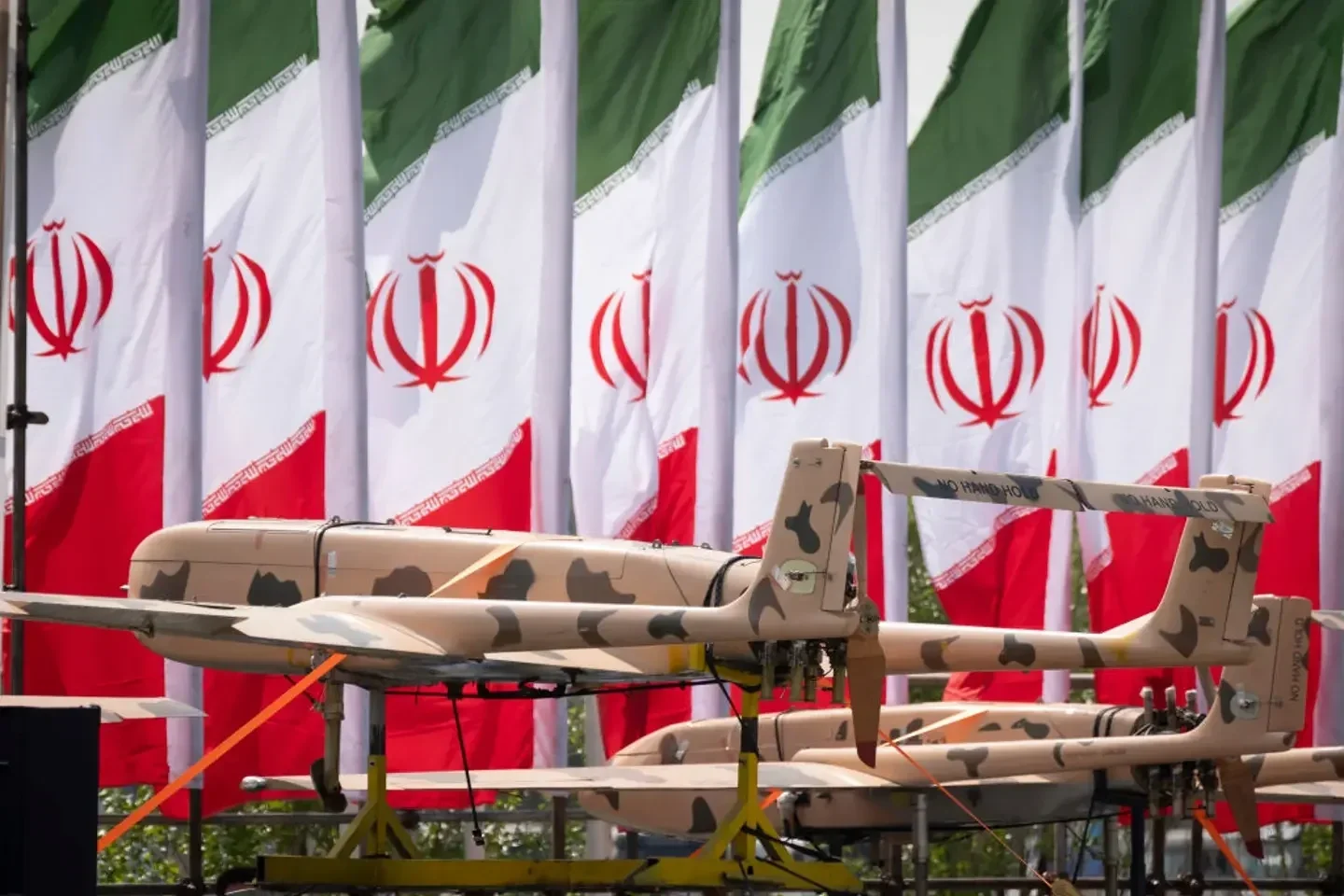
Morteza Nikoubazl—NurPhoto/Getty Images
For decades, Iran has perfected a style of warfare that avoids fighting stronger adversaries head-on. Unlike the United States or Israel, Iran has never possessed overwhelming conventional military superiority. It lacks the advanced air power, naval reach and military alliances that define Western power projection. Yet Iran has never attempted to compete conventionally. Instead, it has embraced what military strategists refer to as asymmetric warfare, a method of conflict whereby a weaker actor exploits vulnerabilities through unconventional means rather than direct confrontation.
Historically, Iran’s asymmetric strategy relied heavily upon regional proxy organisations. Groups such as Hezbollah in Lebanon, Hamas in Gaza, Shiite militias in Iraq, and the Houthis in Yemen enabled Iran to project power beyond its borders while maintaining a degree of plausible deniability. This approach allowed Iran to pressure adversaries, influence regional politics and retaliate against threats without inviting the full consequences of open war.
Yet the strategic environment appears to be changing. While Iran’s proxy system remains important, several of these groups have suffered battlefield depletion, political pressure, leadership losses and logistical constraints. At the same time, Iran has increasingly invested in cyber warfare and sophisticated drone capabilities that offer similar advantages: deniability, lower cost and the ability to impose disruption without triggering immediate large-scale retaliation. In many respects, Iran may not be abandoning asymmetric warfare, but rather evolving it.
The Foundations of Iran’s Proxy Strategy
Iran’s reliance upon proxy organisations stems from necessity as much as ideology. Since the 1979 Islamic Revolution, Iran has viewed itself as strategically encircled by hostile powers. The long and devastating Iran-Iraq War between 1980 and 1988 reinforced a belief among Iranian leaders that conventional military weakness could expose the country to existential threats (Takeyh, 2009).
Rather than compete symmetrically with technologically superior opponents, Iran invested in networks of aligned armed groups across the Middle East. Hezbollah became perhaps the most successful of these relationships. Established with Iranian support during the Lebanese civil war, Hezbollah developed into a powerful political and military actor capable of challenging Israel while simultaneously extending Iranian regional influence (Norton, 2007).
Similarly, Iran cultivated influence among Iraqi militias, supported Palestinian groups, and more recently strengthened ties with the Houthis in Yemen. These organisations offered Iran strategic depth. If Iran came under pressure, retaliation could be outsourced. In effect, Iran created a regional insurance policy.
Importantly, proxy warfare offered deniability. Iran could often deny direct responsibility for attacks carried out by affiliated groups, complicating retaliation by adversaries. This ambiguity formed a central component of Iranian deterrence. Rivals knew Iran may be responsible, but proving direct command remained politically difficult.
The effectiveness of this strategy became increasingly apparent following events such as Hezbollah’s confrontation with Israel in 2006 and Houthi attacks on Gulf infrastructure. Such operations demonstrated that relatively inexpensive unconventional actors could threaten far wealthier and militarily superior states.
Are Iran’s Proxies Becoming Depleted?
The question now emerging is whether Iran’s traditional proxy network is beginning to weaken.
Recent years have exposed vulnerabilities in Iran‘s regional strategy. Sustained military campaigns, leadership assassinations, economic pressures and internal political divisions have affected several Iranian-aligned groups. The war in Gaza has intensified regional tensions, while Israeli military operations against Iranian-linked actors have demonstrated Iran’s growing exposure.
Hezbollah, although still formidable, faces increasing domestic political pressure in Lebanon amid economic collapse. Hamas has suffered severe military degradation following prolonged conflict. Iraqi militias increasingly operate under competing domestic political considerations, while Syria, long viewed as a strategic corridor for Iranian influence, remains unstable.
This does not suggest Iran’s proxy system has collapsed. Far from it. Iran continues to rely heavily upon these networks. Yet there are signs that dependence on proxies alone may no longer provide the flexibility or reliability it once did.
Iran understands that proxy organisations carry risks. They can become politically constrained, militarily vulnerable, or pursue agendas not fully aligned with Iran’s immediate interests. Consequently, Iran appears increasingly attracted to forms of asymmetric warfare that offer more direct control while preserving deniability.
Cyber Warfare: Iran’s Silent Battlefield
If proxy warfare represented Iran’s first generation of asymmetric strategy, cyber warfare may represent the next phase.
Cyberspace provides Iran with a battlefield that avoids conventional military imbalance. Cyber operations are comparatively inexpensive, difficult to attribute with certainty and capable of causing significant economic, political and psychological disruption.
Iran’s cyber evolution accelerated after the 2010 Stuxnet attack, widely attributed to the United States and Israel, which targeted Iranian nuclear centrifuges (Zetter, 2014). The incident served as a strategic shock. Rather than merely strengthening cyber defences, Iran increasingly embraced offensive cyber capabilities.
The 2012 Shamoon malware attack against Saudi Aramco demonstrated this growing sophistication. The attack reportedly wiped data from approximately 30,000 computers, significantly disrupting one of the world’s most important energy companies (Council on Foreign Relations, 2012). Although attribution remains politically contested, many analysts linked the operation to Iranian actors.
Similarly, Operation Ababil between 2011 and 2013 targeted major U.S. financial institutions through distributed denial-of-service attacks. While technically unsophisticated compared to more advanced cyber operations, the attacks revealed Iran’s willingness to disrupt economic systems as a means of signalling retaliation against sanctions and political pressure (Valeriano and Maness, 2015).
Iranian-linked actors have also been accused of cyber espionage campaigns targeting aviation, energy and government sectors, alongside intrusions into critical infrastructure, including the Bowman Avenue Dam incident in New York (U.S. Department of Justice, 2016).
What makes cyber warfare attractive for Iran is that it sits below the threshold of conventional war. Iran can retaliate, impose costs and create uncertainty while reducing the likelihood of overwhelming military response.
Unlike missile strikes or troop deployments, cyberattacks unfold in shadows. Attribution often remains contested, response options are unclear and escalation thresholds become blurred. In strategic terms, cyber operations perfectly complement Iran’s long-standing preference for ambiguity.
The Drone Revolution: Iran’s New Strategic Equalizer
Perhaps the most important development in Iran’s asymmetric arsenal, however, is the rapid expansion of drone technology.
Iran has emerged not only as a drone user but increasingly as a sophisticated drone manufacturer and exporter. What once appeared to be a relatively modest military capability has evolved into one of Tehran’s most effective strategic instruments.
The significance lies partly in economics. Drones are comparatively inexpensive to produce, yet costly to intercept. This creates a powerful asymmetry.
A relatively cheap Iranian-made drone can force an adversary to deploy highly expensive missile defence systems. In military terms, this alters the cost-benefit equation dramatically.
The Shahed family of drones has become particularly significant. Their use in regional conflicts and reported transfer abroad illustrates how Iran has transformed drone technology into both a military and geopolitical tool (International Institute for Strategic Studies, 2023).
Equally important, drones offer Iran flexibility. They can conduct surveillance, precision strikes, harassment operations and swarm attacks while minimising direct risk to Iranian personnel. Much like cyber operations, drones preserve degrees of deniability and strategic ambiguity.
Moreover, drone technology integrates neatly into Iran’s broader asymmetric doctrine. Proxy organisations can use them, Iran can deploy them indirectly and attribution often remains contested long enough to complicate immediate retaliation.
In effect, drones now allow Iran to project power without exposing itself to the vulnerabilities associated with conventional military confrontation.
The significance lies partly in economics
The ongoing conflict has further demonstrated how Iranian drone warfare has evolved from theory into battlefield reality. Drone attacks linked to Iran have increasingly targeted both military and civilian areas across the region, reinforcing concerns that Tehran’s asymmetric strategy no longer remains confined to proxies alone (House of Commons Library, 2026).
U.S. military installations in the Gulf, logistical facilities and allied infrastructure have faced repeated drone threats, exposing vulnerabilities even within highly sophisticated air defence systems (Council on Foreign Relations, 2026). In some cases, drones reportedly penetrated military positions despite advanced interception capabilities, demonstrating how relatively low-cost systems can challenge vastly more expensive defensive technologies, further reinforcing Iran’s asymmetric advantage (International Institute for Strategic Studies, 2023).
Civilian infrastructure has also come under threat, including airports, energy facilities and commercial shipping routes connected to American and allied interests, blurring the traditional distinction between military and civilian targets during periods of escalation (Reuters, 2026).
Such incidents highlight an uncomfortable reality for Western planners: future confrontation with Iran is unlikely to be fought solely through missiles or conventional force, but increasingly through inexpensive unmanned systems capable of disruption, intimidation and strategic signalling far beyond Iran’s borders. Recent assessments suggest Iranian drone and missile attacks have targeted U.S. military facilities, Gulf infrastructure and civilian areas linked to allied states during the present conflict, underlining how drones have become central to Iran’s deterrence and retaliation strategy (Center for Strategic and International Studies, 2024; House of Commons Library, 2026).
Has Iran Adapted its Asymmetric Model?
The central question is not whether Iran has abandoned proxy warfare, but whether it is adapting its asymmetric strategy.
The answer appears to be yes.
Iran is unlikely to abandon proxies altogether. Groups such as Hezbollah remain strategically valuable and continue to serve as regional pressure points. Yet Iran increasingly appears to be diversifying its methods.
Cyber warfare and drone technology offer advantages that traditional proxies cannot always provide. They are cheaper, scalable, technologically adaptable and often less politically complicated. Unlike armed groups with local agendas, cyber units and drone capabilities remain more directly within Iranian control.
More importantly, these tools align with Iran’s broader strategic culture: avoiding direct conventional confrontation while imposing costs on stronger adversaries. Military superiority has never been Iran’s ambition. Strategic disruption has.
In this sense, Iran’s asymmetric warfare is not disappearing; it is modernizing.
Conclusion
Much discussion surrounding Iran tends to focus on the possibility of direct military confrontation with the United States or Israel. Yet such analysis risks misunderstanding how Iran traditionally fights.
Iran rarely seeks open confrontation where it stands militarily disadvantaged. Instead, it relies upon ambiguity, disruption and deniable force to offset conventional weakness.
For years, proxy organisations formed the centrepiece of this strategy. However, changing regional realities suggest Iran increasingly sees cyber warfare and drone technology as equally powerful instruments of influence and retaliation.
As some proxy capabilities face growing strain, cyberspace and unmanned systems appear to be emerging as the next frontier of Iranian asymmetric power.
The battlefield is no longer confined to Lebanon, Iraq or Yemen. Increasingly, it extends into computer networks, critical infrastructure and skies occupied by inexpensive but highly disruptive drones.
For Iran, the future of warfare may not lie in matching stronger adversaries weapon for weapon, but in ensuring their vulnerabilities remain permanently exposed.
References:
Center for Strategic and International Studies (2024) Iran’s Drone Strategy and the Future of Asymmetric Warfare. Washington DC: CSIS.
Council on Foreign Relations (2012) The Shamoon Attacks. Available at: https://www.cfr.org (Accessed: 23 May 2026).
Council on Foreign Relations (2026) Confrontation Between the United States and Iran. Available at: https://www.cfr.org/global-conflict-tracker/conflict/confrontation-between-united-states-and-iran (Accessed: 23 May 2026).
House of Commons Library (2026) Israel/US-Iran Conflict: Background and UK Response. Available at: https://commonslibrary.parliament.uk/research-briefings/cbp-10521/ (Accessed: 26 May 2026).
International Institute for Strategic Studies (2023) Iran’s Drone Capabilities and Regional Influence. London: IISS.
Norton, A.R. (2007) Hezbollah: A Short History. Princeton: Princeton University Press.
Reuters (2026) US carries out new strikes in Iran against military sites and drones. Available at: https://www.reuters.com (Accessed: 24 May 2026).
Takeyh, R. (2009) Guardians of the Revolution: Iran and the World in the Age of the Ayatollahs. Oxford: Oxford University Press.
U.S. Department of Justice (2016) Seven Iranians Working for Islamic Revolutionary Guard Corps-Affiliated Entities Charged for Conducting Coordinated Campaign of Cyber Attacks Against U.S. Financial Sector. Available at: https://www.justice.gov (Accessed: 29 May 2026).
Valeriano, B. and Maness, R.C. (2015) Cyber War versus Cyber Realities: Cyber Conflict in the International System. Oxford: Oxford University Press.
Zetter, K. (2014) Countdown to Zero Day: Stuxnet and the Launch of the World’s First Digital Weapon. New York: Crown Publishing.