The Economic Cost of Drone Warfare
Credit: 9parusnikov / Adobe
Throughout modern history, military power has generally been associated with wealth. The strongest states built the largest armies, operated the most advanced aircraft and maintained the most sophisticated naval forces. Military superiority was often a reflection of economic superiority. Yet the rapid growth of drone warfare is beginning to challenge this traditional relationship. Across the Middle East, Eastern Europe and key maritime chokepoints, relatively inexpensive drones are increasingly generating economic consequences far beyond their cost, creating a new form of warfare in which financial disruption often exceeds physical destruction.
The significance of drones lies not simply in their ability to strike targets but in their capacity to impose disproportionate costs upon their adversaries. A drone costing tens of thousands of dollars can threaten infrastructure worth billions, disrupt international trade routes, increase insurance premiums and force defenders to expend vastly greater resources in response. As a result, drone warfare is reshaping the economics of conflict and altering how military power is exercised in the twenty-first century.
The Economics of Asymmetric Warfare
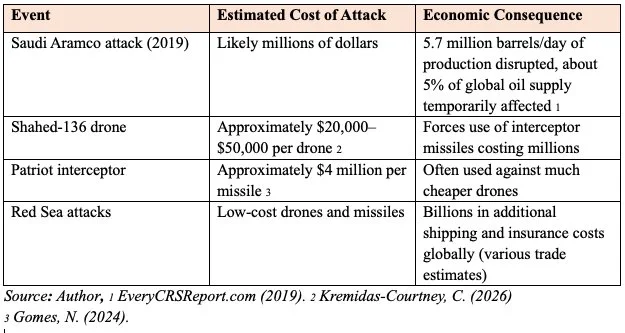
One of the defining characteristics of drone warfare is the growing imbalance between the cost of attack and the cost of defence. Traditional military campaigns required significant resources to generate significant effects. Drones have altered this equation. Iranian-made Shahed-136 drones are estimated to cost between $20,000 and $50,000 each, while a single Patriot interceptor missile used to destroy them can cost approximately $4 million (Reuters, 2026a; Reuters, 2026b).
This disparity reveals a fundamental strategic advantage. An attacker can launch multiple drones at relatively little cost, while the defender must maintain expensive radar systems, command networks and interceptor missiles capable of neutralising the threat. Even when every drone is successfully destroyed, the economic burden frequently falls more heavily upon the defender than the attacker.
The result is a form of economic warfare in which success is measured not solely by damage inflicted but by the costs imposed. In many respects, drones have become the modern equivalent of a financial weapon, capable of forcing adversaries to spend disproportionately large sums simply to maintain security.
The Saudi Aramco Attack: A Turning Point
The economic potential of drone warfare became evident during the September 2019 attack on Saudi Arabia's Abqaiq and Khurais oil facilities. The attack temporarily disrupted approximately 5.7 million barrels of oil production per day, representing roughly half of Saudi Arabia's output and approximately five per cent of global oil supply (Saudi Aramco, 2019; Congressional Research Service, 2019). (Aramco)
The consequences extended far beyond Saudi Arabia. Oil prices surged immediately following the attack as markets reacted to concerns over energy security. Analysts described it as one of the most significant disruptions to global oil supplies in modern history (Al Jazeera, 2019; S&P Global, 2019). (Al Jazeera)
What made the incident particularly significant was the imbalance between the cost of the attack and the economic consequences that followed. Relatively inexpensive drones and missiles temporarily affected a sector responsible for powering much of the global economy. The attack demonstrated that low-cost systems could create market volatility measured in billions of dollars.
For policymakers and military planners, the lesson was uncomfortable. Critical infrastructure worth billions could be threatened by systems costing only a tiny fraction of that value.
Drones and the Cost of Defending the Skies
The conflict in Ukraine has further highlighted the changing economics of warfare. Both Russia and Ukraine have deployed thousands of drones for reconnaissance, targeting and direct attack missions. Many of these systems are relatively inexpensive compared to the assets they threaten.
Military planners increasingly recognise that the challenge is not merely technological but economic. If a defender consistently spends millions of dollars intercepting drones that cost only thousands to produce, the sustainability of that defence strategy becomes questionable. This has encouraged renewed interest in cheaper counter-drone technologies, including electronic warfare systems, directed-energy weapons and low-cost interceptor drones (Reuters, 2026b).
The economic challenge becomes even greater when drones are deployed in large numbers. Swarm attacks can saturate defensive systems, forcing states to choose between accepting risk or expending increasingly costly defensive resources. Future conflicts may therefore be determined as much by industrial production and economic endurance as by battlefield performance.
The Red Sea and Global Trade
Perhaps the clearest example of the broader economic effects of drone warfare can be found in the disruption of international shipping routes. Attacks against commercial vessels in and around the Red Sea have demonstrated how relatively inexpensive drones can affect global commerce.
Modern supply chains rely upon predictable transportation routes. When shipping companies perceive elevated risks, vessels are rerouted, insurance premiums increase and transportation costs rise. These additional costs are ultimately passed on to businesses and consumers.
The economic consequences extend far beyond the region in which the attacks occur. Delays in one maritime corridor can affect manufacturing, retail supply chains and energy markets across multiple continents. The drones themselves may cost only tens of thousands of dollars, yet the resulting economic disruption can be measured in billions.
This illustrates a critical point: drone warfare increasingly targets economic systems rather than purely military objectives. The goal is often not destruction alone but disruption, uncertainty and financial pressure.
The Strait of Hormuz and Global Economic Vulnerability
The Strait of Hormuz remains perhaps the most significant example of this vulnerability. Approximately one-fifth of the world's traded oil passes through this narrow waterway, making it one of the most important maritime chokepoints in the global economy. Recent warnings from Saudi Aramco suggest that prolonged disruption within the Strait could have "catastrophic consequences" for global energy markets and the wider economy (Reuters, 2026c).
In such a scenario, drones become particularly valuable instruments of economic coercion. They offer a relatively inexpensive means of threatening shipping, energy infrastructure and maritime traffic without requiring a direct confrontation between major military forces.
Even the possibility of drone attacks can influence market behaviour. Oil prices, insurance rates and investor confidence often respond to perceived risks before any physical damage occurs. Consequently, the economic effects of drone warfare frequently begin long before a drone reaches its target.
The Future of Cheap Warfare
The growing accessibility of drone technology suggests that these trends will continue. Advances in artificial intelligence, autonomous navigation and commercial manufacturing are reducing barriers to entry for both state and non-state actors. Systems that were once available only to advanced militaries are increasingly accessible to smaller states and irregular groups.
This development has profound implications for international security. Traditional measures of military power may become less relevant when relatively inexpensive technologies can generate strategic effects. The distinction between military and economic warfare is becoming increasingly blurred.
Future conflicts may therefore be characterised by a simple but powerful equation: the side that spends the least may impose the greatest costs.
Conclusion
Drone warfare has fundamentally altered the relationship between military expenditure and strategic effect. Unlike conventional weapons systems, drones offer the ability to generate disproportionate economic consequences at relatively low cost. The attacks on Saudi Aramco, the disruption of international shipping routes and the growing pressure placed upon expensive air-defence systems all demonstrate the same underlying reality.
The significance of drone warfare lies not merely in its destructive potential but in its economic efficiency. A system costing tens of thousands of dollars can influence markets worth trillions. As drone technology continues to proliferate, the greatest threat may not be the damage inflicted upon individual targets but the broader economic instability these systems can create.
In the emerging economics of warfare, cheap weapons increasingly produce expensive consequences.
References:
Al Jazeera (2019) 'Aramco attack: Worst disruption ever sends oil prices soaring', 16 September. Available at: https://www.aljazeera.com/economy/2019/9/16/aramco-attack-worst-disruption-ever-sends-oil-prices-soaring (Accessed: 1 June 2026).
Congressional Research Service (2019) Attacks Against Saudi Oil Rattle Markets. Washington, DC: CRS.
1 EveryCRSReport.com. (2019) ‘Attacks on Saudi Oil Facilities: Effects and Responses’. Available: https://www.everycrsreport.com/reports/IN11173.html. (Accessed June 1, 2026)
3 Gomes, N. (2024). ‘US army awards Lockheed Martin $4.5 billion multi-year Patriot Missiles contract’. Reuters. Available: https://www.reuters.com/business/aerospace-defense/us-army-awards-lockheed-martin-45-bln-contract-2024-06-28 (Accessed June 1, 2026)
2 Kremidas-Courtney, C. (2026) ‘The new economics of warfare’European Policy Centre. Available: https://www.epc.eu/publication/the-new-economics-of-warfare/. (Accessed on June 1,2026)
Reuters (2026a) 'Cheap drones are reshaping the war in the sky', Reuters, 16 March.
Reuters (2026b) 'Inside the Ukrainian interceptor drones wanted around the Gulf', Reuters, 18 March.
Reuters (2026c) 'Aramco sees catastrophic consequences for oil markets if Hormuz Strait remains blocked', Reuters, 10 March.
Saudi Aramco (2019) Incidents at Abqaiq and Khurais. Dhahran: Saudi Aramco.
S&P Global (2019) Saudi Oil Attacks: Market Impact Assessment. New York: S&P Global.
World Bank (2019) Commodity Markets Outlook: Saudi Arabia Box. Washington, DC: World Bank.