The Invisible Battlefield: How the U.S.–Iran Conflict Reshapes the Lives of Ordinary People
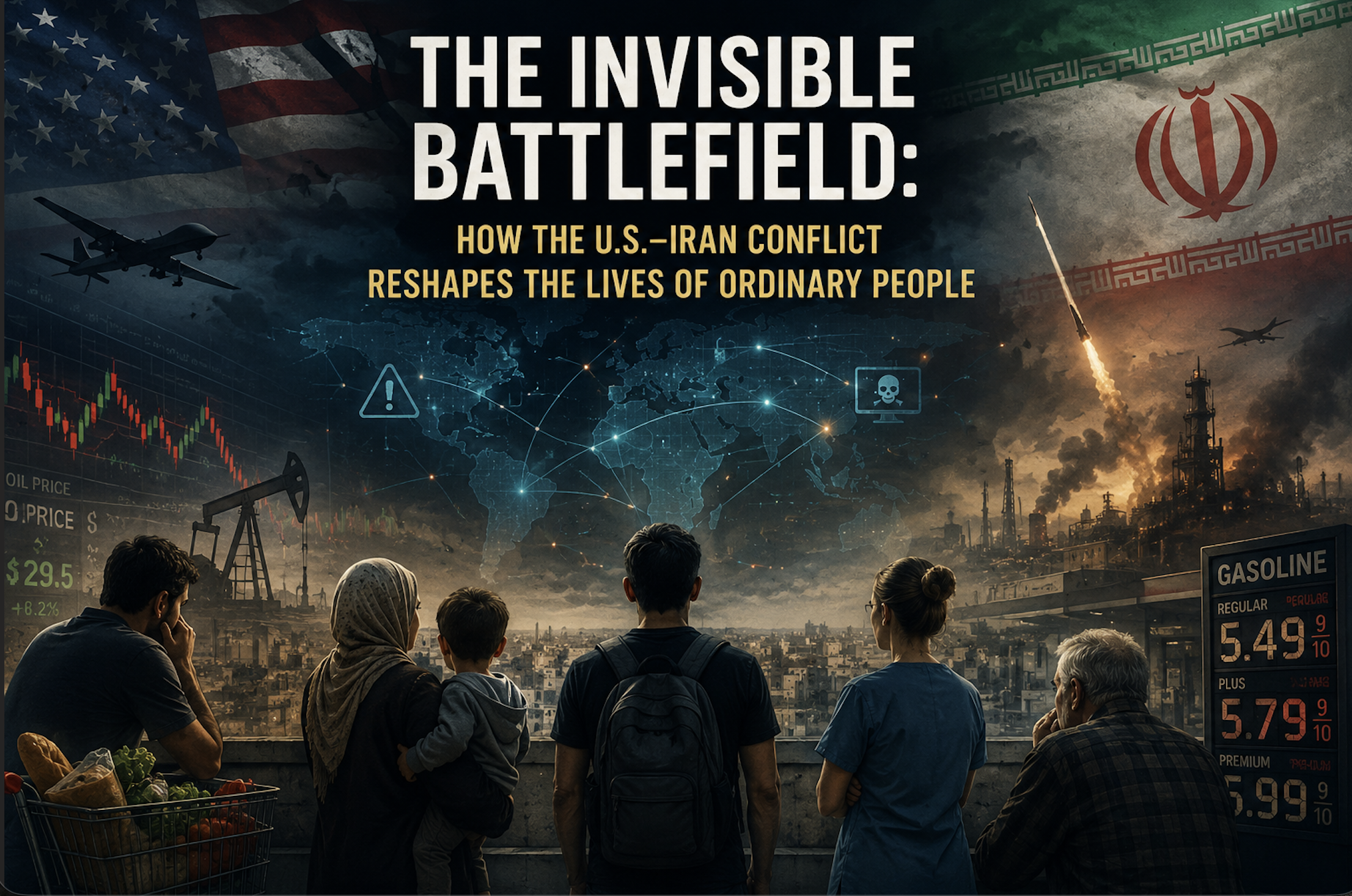
Military conflicts are traditionally judged by battlefield outcomes, territorial change and the achievement of strategic objectives. This essay argues that these measures, while important, no longer provide a complete understanding of modern warfare. Using the U.S.–Iran conflict as a case study, it examines how contemporary war extends beyond the battlefield into economic systems, political institutions and the psychological lives of ordinary people. Its central argument is that modern conflict increasingly tests the resilience of societies as well as the effectiveness of their armed forces.
Introduction
The battlefield no longer ends where the fighting stops.
Every war produces visible casualties. Soldiers are killed, civilians lose their lives, infrastructure is destroyed and governments calculate the military cost of conflict. These losses rightly dominate headlines and military assessments because they are immediate, measurable and deeply tragic. They become the statistics by which wars are remembered and, frequently, the measures by which victory or defeat is judged.
Yet modern warfare also produces consequences that are considerably harder to count.
They can be found in the Iranian graduate questioning whether a future still exists at home, the American family paying more for fuel and household necessities, the European manufacturer confronting unpredictable energy costs and the farmer in a developing economy facing higher fertilizer and food prices. None belongs in the same category as those killed, injured or displaced by war. Yet all may experience consequences created by political and military decisions made thousands of miles away.
The United Nations Development Programmes Human Development Report 1994 challenged the traditional state-centred understanding of security by arguing that security should concern people as well as territory. Its concept of human security broadened the discussion beyond national borders and military capability to include the economic and social conditions that allow individuals to live with dignity and reasonable confidence in their future (United Nations Development Programme [UNDP], 1994).
Three decades later, the U.S.–Iran conflict demonstrates the continuing relevance of that idea. Economic and technological interdependence has reduced the protection once provided by geography. Military confrontation in one region can rapidly affect energy markets, international shipping, investment, inflation and household finances elsewhere.
This essay therefore asks a question conventional military analysis can overlook:
When governments wage war, who ultimately pays the price?
The New Battlefield
Not all battlefields are marked on military maps.
Clausewitz (1976) understood war as an instrument of politics. Military force was not an end in itself but a means through which political objectives could be pursued. That insight remains fundamental. What has changed is the international environment through which military action now produces consequences.
Globalisation has created societies dependent upon international energy markets, financial networks, digital infrastructure and complex supply chains. Keohane and Nye (2012) describe the interdependence created by such relationships: states remain politically sovereign while becoming increasingly exposed to economic developments occurring beyond their borders. Military conflict can therefore travel through these systems even when armies do not.
The Strait of Hormuz provides perhaps the clearest contemporary example. What appears on a map as a narrow maritime passage connects Gulf energy producers with consumers throughout the world. Disruption therefore creates consequences extending far beyond the immediate military theatre. The World Bank (2026) estimates that the Middle East conflict has contributed to higher energy prices, greater inflationary pressure and weaker economic growth, forecasting global growth of 2.5 per cent in 2026. It also warns that higher fertilizer prices could feed through into food costs, creating particular difficulties for developing economies (World Bank, 2026).
Energy markets have become strategic terrain.
The consequences do not stop with oil. Energy is embedded within transportation, agriculture, manufacturing and household consumption. When energy prices rise, transporting food becomes more expensive, manufacturing costs increase and businesses reconsider investment. The OECD (2026) identifies the Middle East conflict as the dominant force shaping the present global economic outlook, with the energy shock pushing inflation higher and weakening growth.
This does not mean that every increase in the price of groceries or gasoline should be described as an act of war. Such language would exaggerate the argument. Rather, it demonstrates how the indirect consequences of military confrontation can be transmitted through systems upon which modern societies depend.
Schelling (1966) argued that coercion concerns influencing an opponent's calculations rather than merely destroying its military capabilities. Today those calculations extend into energy security, financial confidence, infrastructure and public opinion. The ability of societies to absorb disruption has therefore become increasingly relevant to strategic power.
The battlefield now includes the institutions that allow societies to function.
The Iranian Citizen: Patriotism, Uncertainty and the Hope for Change
Nowhere is the distinction between military security and human security more important than inside Iran.
It is tempting for outside observers to interpret Iranian society through a simple political division: those supporting the Islamic Republic and those seeking its replacement. Such a distinction fails to capture the complexity of public opinion. Citizens can criticise their government while defending national sovereignty, desire political reform while fearing instability, or resent economic hardship while opposing foreign military intervention.
Research conducted after the June 2025 Twelve-Day War demonstrates this complexity. Gallagher, Ramsay and Mohseni (2025) found notable evidence of a rally-round-the-flag effect among Iranian respondents, including positive assessments of aspects of the government's and military's wartime performance. Yet the same research found continuing political and economic discontent, with six in ten respondents identifying the economy or aspects of it as Iran's greatest challenge.
That distinction matters.
Mueller's (1970) classic work on the rally effect helps explain why external military threats can strengthen national solidarity without necessarily resolving underlying political grievances. An Iranian citizen may therefore support the defence of the country without supporting every aspect of the political system governing it.
Equally, dissatisfaction with that system should not automatically be interpreted as support for foreign intervention.
War introduces another emotion into this already complicated relationship: uncertainty. Kahneman and Tversky's (1979) Prospect Theory demonstrates the importance of potential losses in decision-making under uncertainty. Applied cautiously to wartime society, it offers a useful way of considering why individuals confronting an unpredictable future may become increasingly reluctant to take risks. Families postpone major purchases. Entrepreneurs delay investment. Graduates reconsider whether to build careers at home. Parents question whether their children will inherit greater opportunity or prolonged insecurity.
These decisions will never appear in military casualty figures. Yet collectively they can reshape a country.
The economic background makes these decisions still more difficult. The IMF currently projects Iran's economy contracting by 5.4 per cent in 2026 while consumer-price inflation reaches 68.9 per cent (International Monetary Fund [IMF], 2026a). Such figures are macroeconomic measurements, but for ordinary citizens they translate into diminished purchasing power, uncertainty over savings and increasingly difficult decisions about the future.
This is where the psychology of the conflict becomes particularly difficult to interpret. War may strengthen attachment to the nation while simultaneously increasing frustration with the circumstances in which people live. It may generate hope among some that political change will follow, fear among others that change imposed through war will produce greater instability, and both emotions within the same individual.
We should therefore resist claiming to know what “the Iranian people” want.
There is no single Iranian response.
What the available evidence allows us to say is more restrained and perhaps more important: external threat can strengthen national solidarity without extinguishing aspirations for economic, political or social change.
Perhaps one of the least visible costs is therefore expectation itself. Roads and buildings can eventually be reconstructed. Restoring confidence that education will produce opportunity, savings will retain their value and tomorrow will be more secure than today may take considerably longer.
The American Citizen: A Distant War Comes Home
The experience of Americans is fundamentally different.
Most Americans do not confront bombardment, displacement or the destruction of their communities. Equating their experience with that of civilians living inside the conflict would diminish the severity of what those populations endure.
But distance does not mean immunity.
For Americans, the conflict arrives primarily through economic, political and personal channels. Energy prices provide the most obvious example. When disruption in the Gulf reduces global supply or raises fears about future availability, the consequences can reach American consumers through fuel and transportation costs before spreading more widely through the economy.
The IMF's July 2026 outlook found that the global disinflation process had stalled, with global headline inflation revised upward to 4.7 per cent for 2026 (IMF, 2026b). Importantly, however, the IMF also concluded that the international economy had weathered the war-related shock better than initially feared, helped by inventories, expanded production outside the Gulf, renewable energy and declining energy intensity.
That qualification matters.
A serious assessment of war should not select only evidence that supports a predetermined argument. The international economy has been disrupted by the conflict, but it has also demonstrated an ability to adapt. Resilience is therefore not merely something war threatens. It is one of the mechanisms through which societies limit the consequences of war.
At household level, however, inflation and uncertainty alter behaviour. Families reconsider discretionary expenditure. Prospective homebuyers confront uncertainty over affordability and interest rates. Retirees become more cautious about savings and investments. Businesses reconsider expansion when future costs become more difficult to predict.
Again, none of these experiences is comparable to physical injury, bereavement or displacement. They demonstrate something different: the ability of geographically distant conflict to penetrate civilian life through economic systems.
There is also a human burden much closer to the traditional experience of war. Behind every military deployment are families living with the possibility of injury, escalation or loss. Their anxiety rarely appears in strategic assessments, yet it is one of the most direct ways a distant war enters American homes.
The political consequences are becoming visible as well. A Reuters/Ipsos poll conducted five months into the war found only 35 per cent of Americans supporting it, while half expected the conflict to leave the Middle East more chaotic rather than more stable (Reuters/Ipsos, 2026). Public confidence in the purpose and outcome of military action is itself therefore becoming part of the strategic environment.
The American experience reinforces rather than contradicts the essay's central argument. Modern conflict affects different populations with radically different levels of severity, but its consequences are no longer confined to those geographically closest to the fighting.
When the World Pays
The argument becomes more striking when the people bearing the consequences belong to neither belligerent.
The World Bank's June 2026 assessment describes the Middle East conflict as a major shock to the international economy. Higher energy prices, greater inflation and borrowing costs are expected to weaken global growth, while developing economies face particularly difficult conditions. Growth in developing economies is projected to fall to 3.6 per cent in 2026, compared with 4.4 per cent in 2025 (World Bank, 2026).
Consider the chain of consequences.
Conflict disrupts energy supplies. Energy prices rise. Shipping and manufacturing become more expensive. Fertiliser costs increase. Food production becomes more expensive. Households thousands of miles from the battlefield pay more for basic necessities.
No missile needs to reach them.
This is where economic interdependence becomes both a strength and a vulnerability. The same systems that allow goods, capital and energy to move efficiently during periods of peace also transmit disruption during periods of conflict.
The consequences are not distributed equally. Advanced economies generally possess greater financial capacity to diversify energy supplies, support industries or cushion vulnerable households. Developing economies frequently possess fewer options. The OECD (2026) warns that prolonged disruption would impose particularly severe economic and social costs on countries most exposed to energy and food-price shocks.
Those least responsible for a conflict may sometimes be among those least able to afford its consequences.
A farmer facing higher fertilizer prices, a manufacturer confronting rising energy costs and a family spending a greater proportion of its income on food are not casualties in the conventional meaning of the word. But they are bearing part of the cost.
That distinction is essential. The idea of the invisible battlefield should broaden our understanding of war, not trivialize its physical horrors.
Rethinking Victory
This brings us to the central policy question.
How should victory be measured?
Traditional strategic analysis asks whether military objectives were achieved, whether an adversary's capabilities were degraded and whether deterrence was restored. Governments and armed forces must continue asking these questions.
But they should also ask others.
Did society withstand the economic shock? Did political institutions retain legitimacy? Did critical infrastructure continue functioning? Did citizens retain confidence in the future?
Buzan, Wæver and de Wilde (1998) argue that security extends across military, political, economic and societal sectors. The U.S.–Iran conflict demonstrates the usefulness of that broader framework. A country may possess formidable armed forces while remaining vulnerable through energy dependence, economic instability, damaged infrastructure or political fragmentation.
This does not replace Clausewitz. It extends the question he posed about the relationship between military force and political purpose.
If military action exists to produce greater political security, then the condition of society after military action matters. Tactical success that produces lasting economic weakness, political instability or diminished national confidence cannot automatically be regarded as complete strategic victory.
National resilience therefore deserves a more prominent place within strategic analysis.
Resilience is not passive endurance. It is the capacity of a society to absorb disruption without losing the institutions, economic functions and public confidence upon which national power ultimately depends.
This has practical implications. Energy diversification becomes part of security policy. Protecting digital and physical infrastructure becomes security policy. Maintaining trusted institutions becomes security policy. Preserving supply chains and emergency reserves becomes security policy.
Military power remains indispensable.
But the society it exists to protect is itself part of national power.
Conclusion
The U.S.–Iran conflict will eventually be assessed through familiar measures. Analysts will count casualties, calculate expenditure, examine weapons performance and determine which strategic objectives were achieved.
Those assessments will be necessary.
They will not be sufficient.
The Iranian graduate reconsidering a future at home, the American household absorbing higher costs, the European manufacturer postponing investment and the farmer confronting higher agricultural inputs occupy profoundly different circumstances. Their experiences should never be treated as equivalent.
What connects them is something else.
Their lives have been altered by political and military decisions over which they exercise almost no control.
That is the invisible battlefield.
It does not replace the physical battlefield. Nor does it turn every economic inconvenience into a casualty of war. Rather, it reveals an additional dimension of contemporary conflict: military confrontation now travels rapidly through the economic, political and psychological systems upon which ordinary life depends.
The policy implication is straightforward. Governments preparing for future conflicts must think beyond military resilience. Energy security, economic adaptability, infrastructure, institutional trust and social cohesion increasingly form part of strategic power.
Perhaps this is how the U.S.–Iran conflict should ultimately be remembered—not only for what happened on the battlefield, but for what it revealed about warfare beyond it.
History will ask who won.
We should also ask who paid the price.
References
Buzan, B., Wæver, O., & de Wilde, J. (1998). Security: A new framework for analysis. Lynne Rienner Publishers.
Clausewitz, C. von. (1976). On war (M. Howard & P. Paret, Eds. & Trans.). Princeton University Press. Available at: https://shorturl.at/CsLAu (Original work published 1832).
Gallagher, N., Ramsay, C., & Mohseni, E. (2025). Iranian public opinion soon after the Twelve-Day War Available at: https://shorturl.at/YggJr Center for International and Security Studies at Maryland, University of Maryland.
International Monetary Fund. (2026a). ‘Islamic Republic of Iran: Country data’. Available at: https://www.imf.org/en/countries/irn#countrydata International Monetary Fund.
International Monetary Fund. (2026b). ‘World economic outlook update, July 2026’. Available at: https://www.imf.org/en/news/articles/2026/07/08/tr070826-weo-press-briefing-transcript-july-8-2026 International Monetary Fund.
Kahneman, D., & Tversky, A. (1979). ‘Prospect theory: An analysis of decision under risk’. Econometrica. Available at: https://shorturl.at/nmunn Econometrica, 47(2), 263–291.
Keohane, R. O., & Nye, J. S., Jr. (2012). ‘Power and interdependence’ (4th ed.). Longman.
Mueller, J. E. (1970). Presidential popularity from Truman to Johnson. American Political Science Review, 64(1), 18–34. Available at: https://shorturl.at/qUoW1
Organisation for Economic Co-operation and Development. (2026). OECD economic outlook, volume 2026 issue 1. OECD Publishing.
Reuters/Ipsos. (2026, August 6). Iran war drags on; Americans brace for more chaos in the Middle East [Poll report]. Reuters.
Schelling, T. C. (1966). Arms and influence. Yale University Press.
United Nations Development Programme. (1994). Human development report 1994: New dimensions of human security. Available at: https://hdr.undp.org/content/human-development-report-1994 UNDP.
World Bank. (2026). ‘Global economic prospects’ Available at: https://shorturl.at/yWXh8 June 2026. World Bank.